

A design responsibility matrix is a grid that maps every design deliverable against every project role, showing who does the work, who approves it, who advises, and who just needs to know. A key rule to maintain effectiveness is that each task has exactly one Accountable person within the RACI framework. Get that right and the matrix stops arguments before they start.
TL;DR:
- Ensuring exactly one Accountable person per task prevents confusion and delays during approvals and project completion.
- A responsibility matrix is most valuable on multi-discipline projects with concurrent task stages, especially between RIBA Stages 2 to 4.
- Building the matrix should follow a structured process: define stages, list roles, assign deliverables, and verify one A per row, with stakeholder workshops.
- Common failures include multiple As on one task and too many Consulted roles, which can be fixed by splitting tasks and tightening input scope.
- Maintaining a live, reviewed responsibility matrix with clear deadlines and a dedicated owner prevents it from becoming outdated or ignored.
Table of Contents
- When does a design project actually need a responsibility matrix?
- What do R, A, C and I actually mean on a design project?
- How do you build a design responsibility matrix step by step?
- Where does the matrix sit in RIBA and BIM documentation?
- What goes wrong with a design responsibility matrix, and how do you fix it?
- What does a working design responsibility matrix look like?
- Why templates alone won’t fix a bad matrix
- Need help populating and maintaining your DRM?
- Sources
When does a design project actually need a responsibility matrix?
A design responsibility matrix lists deliverables and stages down one side and roles across the top, with each cell marked to show who does what. It sounds administrative until you watch a project without one: occasionally two consultants both assume ownership of an element like the fire strategy, leading to issues surfacing late in the project.
Designing Buildings Wiki describes a design responsibility matrix as a document setting out responsibility for each element of the design at each stage, usually alongside RIBA Plan of Work documentation. That framing matters because it ties the matrix to specific stages, not a vague project-wide assignment.
The payoff shows up in a few concrete ways:
- Approvals get faster because everyone knows who signs off, not just who contributed.
- Rework drops because gaps in scope surface in a workshop, not on site.
- Overloaded team members become visible before deadlines slip, not after.
A matrix earns its place on multi-discipline, multi-stage schemes: anything with structural, MEP, and architectural teams working concurrently across RIBA Stages 2 to 4. On a single-discipline job with two people in a room, you probably don’t need one. On anything bigger, skipping it is how design responsibility quietly falls through the cracks between consultants.
What do R, A, C and I actually mean on a design project?
RACI divides responsibility into four categories, and the University of Essex’s guidance on responsibility matrices sets out the standard definitions clearly:
- Responsible – does the work. The structural engineer who produces the reinforced concrete calculations.
- Accountable – owns the outcome and signs it off. The lead designer who approves the structural scheme before issue.
- Consulted – gives input before a decision is finalised. The MEP engineer flagging duct zones before the structural grid is fixed.
- Informed – told after the decision, no input required. The contractor notified once a foundation detail is confirmed.
The golden rule is non-negotiable: exactly one Accountable per task. Two As on a row means nobody actually owns it. When a query lands during construction, both parties assume the other answered it. That’s the approval circus GIRI research on design errors explains the confusion that arises when accountability is ambiguous, leading to unresolved queries.
Larger or multi-client projects sometimes extend RACI into RASCI (adding Support) or DACI (Driver, Approver, Contributor, Informed), useful where a decision owner differs from a task doer. For most design teams, plain RACI is sufficient and easier to police.
How do you build a design responsibility matrix step by step?
Building a workable matrix is less about the template and more about the sequence you follow. Rush the roles list and you’ll spend the workshop arguing about who’s even in the room.
- Fix your stage granularity first. Use RIBA Stages (2, 3, 4) or your own project stages as columns headers, not arbitrary dates. This anchors the matrix to a recognised framework everyone already understands.
- List roles, not names. list roles such as “Structural Engineer” rather than individual names. People change; roles don’t, and the matrix should survive a staff change without a rewrite.
- List deliverables down the rows. derive deliverables from your scope of works or MIDP such as structural scheme, drainage strategy, and fire engineering report.
- assign R, A, C, or I codes to each cell in the matrix. Work row by row, not column by column, so you catch gaps in a single deliverable rather than jumping between them.
- Run the one A check. verify every row contains only a single Accountable assignment; resolve duplicates immediately.
- Cap the Cs. More than two or three Consulted roles on a single row usually means the task needs splitting, not more input.
- Workshop it with stakeholders. discuss the draft matrix in meetings rather than just via email. Disagreements surface faster face to face, and practitioner guidance on RACI processes backs starting high-level and drilling into detail only for interface-heavy items.
- document approval and establish dates for subsequent reviews. A matrix without a review date goes stale the moment the team changes.
- Link it to your MIDP and TIDP, and keep it live through procurement as new subcontractor design responsibilities appear.
Pro Tip: Run the one-A check as a live exercise in the workshop, not afterwards on your own. Watching two people both claim accountability for the same row, out loud, resolves the argument in minutes instead of over email for a week.
Where does the matrix sit in RIBA and BIM documentation?
the responsibility matrix functions as part of the overall information management framework. It sits inside your information management structure, and getting the placement right stops it becoming shelfware.
RIBA’s own toolbox provides ready-made templates: the RIBA Plan of Work toolbox includes a Project Roles Table and a Design Responsibility Matrix spreadsheet, both built to sit alongside the eight RIBA stages. Starting from these rather than a blank spreadsheet saves a genuine amount of setup time.
A few placement points worth getting right:
- Your DRM rows should map directly to entries in the Master Information Delivery Plan (MIDP) and Task Information Delivery Plans (TIDP), not sit as a parallel, disconnected list.
- Deliverables should reference their Level of Definition (formerly Level of Detail/Information) so the matrix ties responsibility to a specific output quality, not just a task name.
- UK BIM guidance on information delivery recommends responsibility indicators be used consistently across production, authorisation, and review stages, echoing the PAS 1192 approach to information management.
- The matrix must be updated the moment team members change or a subcontractor is appointed during procurement. A matrix frozen at Stage 2 is actively misleading by Stage 4.
What goes wrong with a design responsibility matrix, and how do you fix it?
Most DRM failures aren’t complicated. They’re the same three or four mistakes repeated on every project.
Multiple As on one row is the most damaging. It looks harmless in a spreadsheet, then causes a genuine standoff when a query needs resolving fast. Fix it by splitting the task into sub-deliverables with a single owner each, rather than trying to negotiate joint accountability.
Too many Cs is the second common fault. rows with too many Consulted roles indicate the task may be too broadly defined. Break it down until each piece has a tight, sensible circle of input.
A few other checks worth running before sign-off:
- Confirm the matrix has an owner responsible for updates, not just an author who built it once.
- Set a review trigger tied to stage gateways, not a fixed calendar date that ignores project slippage.
- Add explicit client approval deadlines into the matrix itself. Omitting these is a common cause of stalled engineering output, because nobody chases a deadline that was never written down.
- Cross-check the matrix against the MIDP quarterly, or at every stage gateway, whichever comes first.
Pro Tip: Give the DRM a named owner separate from the project lead. Project leads get pulled into fires; a matrix owner whose only job is currency checks won’t let it drift.
What does a working design responsibility matrix look like?
A compact example makes the RACI logic concrete faster than any explanation. Here’s a simplified Stage 3 matrix using generic roles:
Look at the drainage strategy row. The MEP engineer is both Responsible and Accountable, because they produce and own that deliverable end to end. The client and structural engineer are Consulted, since drainage routing affects foundations and site levels, but neither has approval authority. That keeps the row to three input roles, well within the cap.
Compare that with the temporary works brief. The structural engineer is Accountable even though the contractor does the Responsible work, because in most UK contracts the structural engineer retains a design-check obligation over temporary works even where a specialist produces the detail.
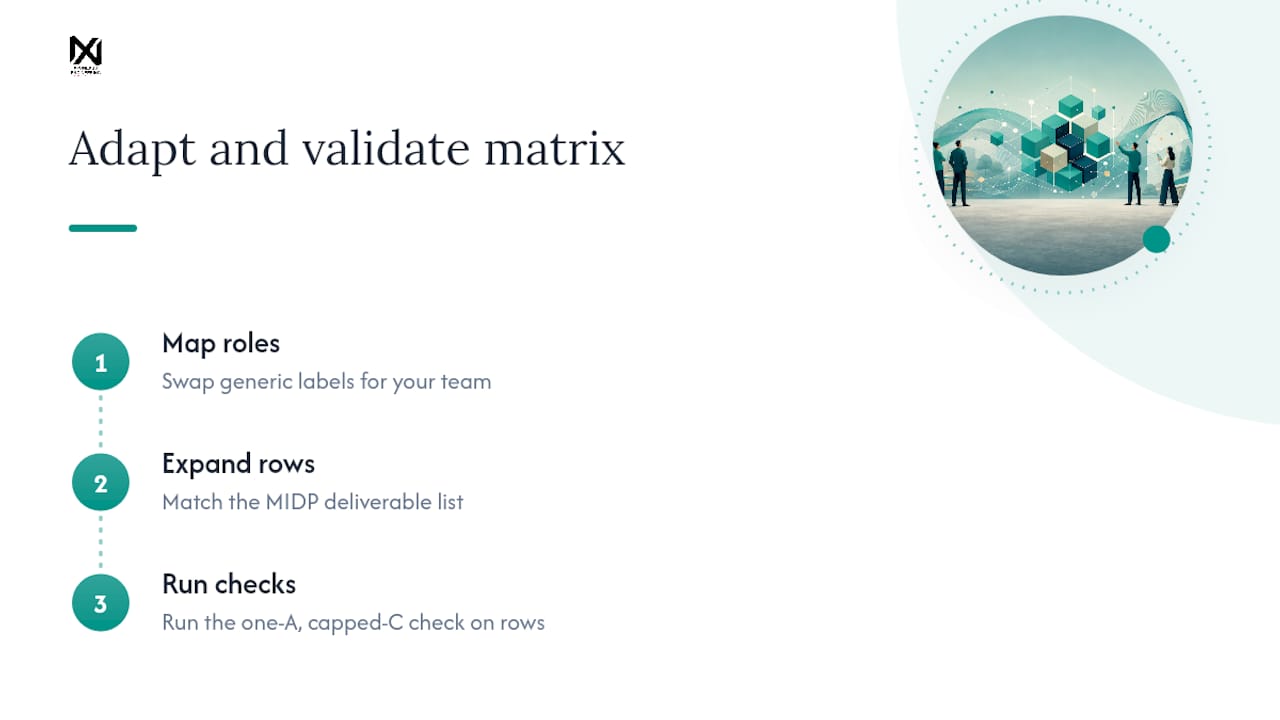
Adapting this to your own project means swapping generic role labels for your actual team structure, expanding rows to match your MIDP deliverable list, and running each row through the one-A, capped-C check before anyone signs it off.
Why templates alone won’t fix a bad matrix
The template isn’t where projects go wrong. Every RIBA toolbox spreadsheet looks fine on the screen. What breaks is the negotiation that’s supposed to happen before anyone fills in the cells, and most teams skip straight past it.
Conventional advice treats the DRM as a document to produce and file. That’s backwards. The value sits in the argument you have in the workshop when two consultants both think they own the same deliverable, not in the PDF you email round afterwards. GIRI’s research on design scope makes a similar point: it’s the vague scope conversation, not the missing paperwork, that causes rework. A matrix built without that friction is just a spreadsheet nobody trusts.

If you take one thing from this, prioritise the review date over the initial build. Teams spend hours perfecting the first version, then let it go stale the moment a subcontractor gets appointed or a role changes hands. A mediocre matrix reviewed every stage gateway beats a beautiful one nobody’s opened since Stage 2.
The other thing genuinely underrated: capping Consulted roles. Everyone obsesses over the one-A rule because it’s the memorable headline. Bloated C columns cause just as much drag, quietly, by turning every decision into a five-person email thread.
— Mohammed
Need help populating and maintaining your DRM?
Building the matrix is one job. Keeping it live through Stage 3 and 4, while producing the actual calculations and drawings each row promises, is another. Xponexusengineering exists for exactly that gap: embedded remote engineers who slot into your existing workflow and take on the deliverables your DRM assigns, without you carrying a permanent hire’s overhead.

Our engineers work under NDA, kick off within 48 hours, and produce review-ready calculation packages and BIM-coordinated drawings aligned to UK standards and Eurocodes. That means the Responsible cells in your matrix get filled by someone who already understands RACI structure and RIBA-stage deliverables, not someone learning your project from scratch. We handle the coordination and sign-off tracking; you keep the client relationship and final Accountability where it belongs.
If your team is stretched across too many Responsible rows this quarter, look at our structural and civil engineering services and get a project quote started.
Leave a Reply