
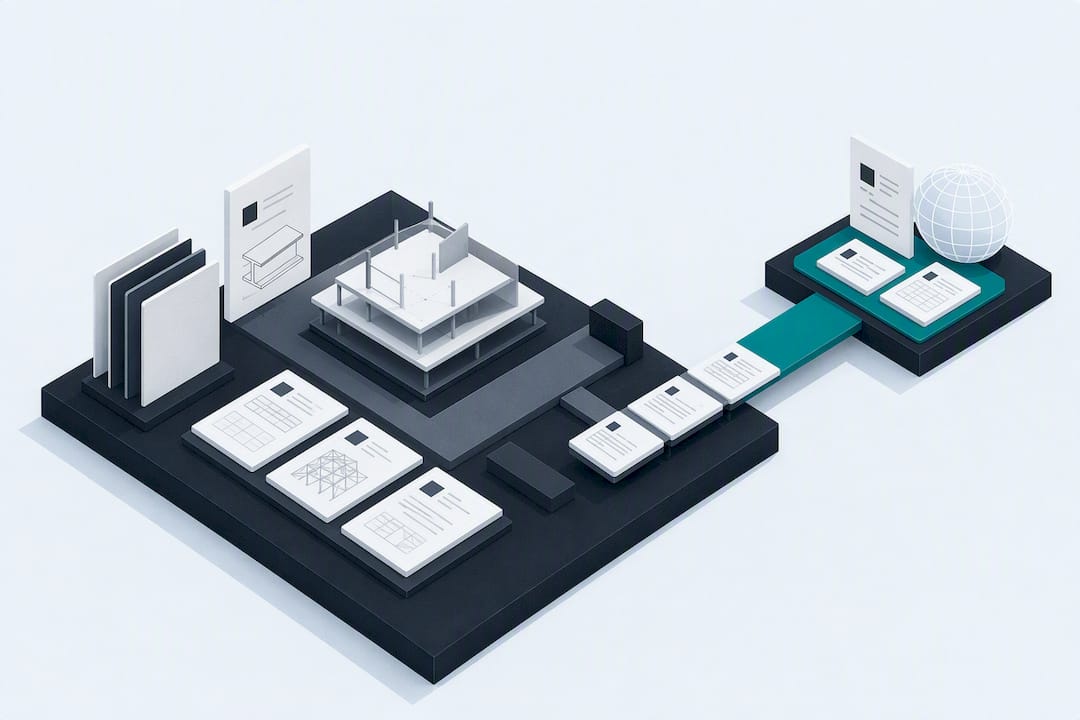
The right model for engineering document control is embedding remote civil and structural engineers directly into your project workflow, governed by your BIM Execution Plan and a named internal QA reviewer. Xponexus Engineering runs this model with a 48 hour kick off, an NDA on day one, and cost savings against local hires. Before you commit, insist on three things: BEP and CDE alignment, a named QA sign off, and a short paid pilot.
TL;DR:
- Embedding remote engineers requires clear issue of BEP and CDE access on day one, along with defined Level of Development and structured onboarding.
- A designated internal reviewer must sign off work at key milestones, using a simple revision and status system to avoid stale or unapproved outputs.
- Contracts should include NDAs, IP assignment, data security, and SLAs before starting any technical engagement for legal and operational clarity.
- Conduct a short, paid pilot with a real task to validate quality, turnaround, and communication, enabling better decision-making before full commitment.
- Aligning engineers to your standards and review processes is crucial to prevent rework, communication gaps, and delays that can occur when integrating remote technical resources.
Table of Contents
- What does ‘engineering document control’ actually cover?
- Why embed remote engineers instead of hiring or outsourcing a project?
- How do you set up document control for a remote engineer?
- Who signs off the work, and how do changes get tracked?
- What should the contract cover before you engage anyone?
- How do you pilot a remote engineer before committing?
- Operational lessons from embedding remote engineers
- Xponexus Engineering: an embedded model built for UK Eurocode work
- Where to check BEP, ISO 19650 and outsourcing standards
- Sources
What does ‘engineering document control’ actually cover?
This is not about document management software, version control platforms, or the corporate procedures that IT departments run to track file revisions. That’s a different discipline entirely, and if you’ve landed here looking for PDM or PLM software comparisons, you’re in the wrong place.
Engineering document control, in the sense that matters to a consultancy weighing up outsourced capacity, means the production and management of the actual technical outputs: drawings, calculation packages, and BIM deliverables produced by engineers who sit inside your workflow but aren’t on your payroll. It’s the discipline of getting review-ready work out of a remote team member, on time, in the right format, without you having to redo half of it.
A properly embedded remote engineer working under your BEP should be producing:
- Review-ready structural and civil drawings, issued through your standard title block and revision system
- Calculation packages with checked references, ready for a senior engineer’s signature
- BIM exports in RVT and IFC formats, matched to your model structure and naming convention
- Schedules, quantity take-offs, and drawing mark-ups tied to specific revision cycles
The standard here is that outputs arrive matching your Common Data Environment conventions, not a version the embedded engineer happened to find convenient.
Why embed remote engineers instead of hiring or outsourcing a project?
Capacity on demand is the obvious draw. You take on a specialist for a six month structural package without carrying them on the books once the project closes. The bigger, less obvious benefit is skills access: an embedded remote structural engineer familiar with Eurocode design can plug straight into overflow work that would otherwise sit in a queue for weeks.
Cost savings run real but variable. Firms report meaningfully lower fixed overhead when outsourcing BIM and drafting work, particularly when a BEP and QA process are actually followed rather than treated as paperwork. Speed improves too, because a specialist who does nothing but reinforced concrete calculations all day moves faster than a generalist splitting attention across five projects.
The trade-offs are just as real:
- Governance gaps if nobody owns the BEP relationship on your side
- Onboarding time before an embedded engineer understands your template library and house style
- Limited overlap windows if time zones or working patterns don’t align
- Communication drift when stand-ups and reviews aren’t scheduled with intent
Staff augmentation models typically deploy engineers within 7 to 14 days, against a longer lead time for full outsourced project delivery. That gap alone often decides which model a firm picks.
How do you set up document control for a remote engineer?
Getting an embedded engineer producing usable work fast comes down to giving them the same rails your in-house team already runs on, not a simplified version.
- Issue the project BEP and CDE access on day one. A remote engineer working from a verbal brief will guess at naming conventions and workset rules, and guesses cost you review time later.
- Define LOD by phase, in writing. State whether you need Stage 3 RVT models, issued IFC exports, or stamped PDF drawings, and specify calculation packs with fully checked references, not draft workings.
- Run a structured onboarding checklist, covering CDE and software accounts, a sample task before live work starts, and access to your template calculation sheets and BIM family libraries.
- Set a meeting cadence and overlap window. A short daily stand up and one substantive weekly review, timed to a window where both sides are actually online, prevents small misunderstandings becoming rework.
A qualified outsourcing partner should already have a sample BEP ready to show you, along with evidence of CDE use and clarity on RVT, IFC and PDF handover formats. If they can’t produce one unprompted, that’s your answer before you’ve even started.
Pro Tip: Ask for the embedded engineer’s first deliverable against a task you’ve already completed internally. Comparing their output to a known answer tells you more about naming discipline and LOD compliance than any interview question.
Who signs off the work, and how do changes get tracked?
Every engagement needs one named person on your side who does the final audit before anything gets issued. Not a committee, not “the team”, one named internal reviewer who owns the checklist and the sign off stamp.
Document states should follow a simple three tier system: WIP (work in progress, not for distribution), Shared (available for coordination and comment), and Published (issued, numbered, and locked against further edit without a formal revision). Pair that with a revision numbering system that increments predictably, so nobody’s working from a stale drawing by accident.
A short QA checklist covering both drawings and calculation packs should check, at minimum, model structure and naming conventions, view templates, purge and compact discipline, clash detection frequency, and the review cycle itself, criteria that BIM outsourcing checklists consistently flag as the difference between clean sets and noisy ones. Changes get logged and approved inside the CDE itself, using BCF issues or formal transmittals rather than email threads that vanish into someone’s inbox.
| Control | What it prevents |
|---|---|
| Named reviewer sign off | Unchecked work reaching the client |
| WIP / Shared / Published states | Stale drawings being used by mistake |
| BCF or transmittal logging | Untracked changes and lost audit trail |
| Standard QA checklist | Naming and modelling inconsistencies |
What should the contract cover before you engage anyone?
Get the paperwork right before the technical relationship starts, because retrofitting protection after a dispute is far harder than writing it in on day one.
- NDA and IP assignment, signed before any project files are shared, with clear language on who owns the deliverables.
- Data security terms, covering where files sit, who has CDE access, and how access is revoked when the engagement ends.
- Replacement guarantees, so a departing engineer doesn’t leave you exposed mid project.
- SLAs on turnaround and response times, plus a stated number of permitted revision rounds per deliverable.
- A choice of engagement shape: staff augmentation for direct control inside your team structure, project based outsourcing for defined scopes, or a managed team for larger, ongoing capacity.
Staff augmentation tends to suit firms with internal technical leadership able to direct embedded engineers day to day; without that leadership in place, a managed team model is usually the safer route. Sample acceptance criteria worth writing into the scope: on-time delivery rate, error rate against your QA checklist, and format compliance on first submission, not after three rounds of correction.
How do you pilot a remote engineer before committing?
Skip the trial and you’re gambling on a full engagement based on a CV and a video call. A short, paid pilot removes the guesswork.
- Scope a small, real package: a modest modelling task, a clash report, and a calculation note tied to an actual (or recently completed) project.
- Score it on four axes: quality against your checklist, completeness of the handover, turnaround against the agreed deadline, and clarity of communication during the task.
- Keep it short, typically one to two weeks, with go or no-go criteria agreed before the pilot starts, not argued over afterwards.
A scoped paid pilot is the industry-recommended way to validate technical fit before any larger commitment, and a brief familiarisation period on top of it tends to pay for itself in reduced early rework.
Operational lessons from embedding remote engineers
The onboarding checklist and the named QA reviewer aren’t bureaucracy, they’re what stops a promising pilot turning into six months of noisy drawing sets. Treat the embedded engineer as part of your team’s rituals, not a vendor you check in on weekly, and the model holds up.
— Mohammed
Xponexus Engineering: an embedded model built for UK Eurocode work
This embedded document control model offers capacity without the overhead of a permanent hire. Engineers work inside your workflow under UK standards and Eurocodes, with an NDA signed before any file changes hands and a quick project kick-off, so you’re not waiting weeks to see whether the fit works.

In the first 30 days, expect onboarding against your BEP and CDE conventions, a sample task before live work starts, and a named point of contact on both sides. Cost savings against local hires are often reported, while the client relationship remains entirely in your hands. If you want to test the model rather than take it on faith, ask about a scoped pilot through the engineering services page and see the output before you decide anything larger.
Where to check BEP, ISO 19650 and outsourcing standards
- Staff augmentation guide for UK companies, for firms weighing engagement models against IP control
Leave a Reply