
A successful kickoff ends with an approved charter, every stakeholder invited and briefed, pre-reads read (not just sent), logistics locked down, roles named, and at least one action already assigned before anyone leaves the room. Get those six things done and the project starts on solid ground rather than guesswork. Miss any one of them and you spend week three fixing what should have been settled on day one.
TL;DR:
- An effective project kickoff requires final approval of the charter with SMART objectives and a thorough stakeholder analysis before scheduling the meeting.
- Pre-reads, including the charter, timeline, budget, and risks, should be sent early with specific questions to encourage review and questions from attendees.
- During the meeting, clear confirmation of purpose, scope, roles, responsibilities, risks, and decision owners is essential, with time limited to keep progress on track.
- Immediate follow-up within 24 hours, including distributing notes, updating the project workspace, and creating initial tasks, is critical to maintaining momentum.
- Using standardized templates for the charter, agenda, RACI, and action tracker ensures consistency and helps prevent early project miscommunication or duplicate work.
Table of Contents
- Project kickoff checklist: the printable version
- What to prepare before the kickoff meeting
- Running the meeting: agenda, timing and facilitation
- What happens in the 24 hours after kickoff
- Templates and tools worth setting up now
- How embedded engineering teams shorten kickoff ramp time
- Where standard kickoff advice falls short
- A faster route to engineering capacity at kickoff
- Sources
- FAQ
Project kickoff checklist: the printable version
Copy this into your meeting invite or project space and tick items off as you go. The pattern behind it comes from cross-industry practice, not one team’s habit, which is why it holds up across sectors.
Before the meeting
- Charter or business case signed off by the sponsor, with SMART objectives attached
- Stakeholder list finalised, with attendance confirmed for anyone who must be there
- Pre-reads (charter, timeline, budget summary, top risks) sent several days ahead
- Room booked or virtual link tested; note taker assigned
During the meeting
- Purpose, scope and success criteria confirmed aloud, not assumed
- Timeline, roles and communication cadence walked through with named owners
- Risks surfaced and logged; parking lot used for anything off-topic
After the meeting
- Notes and action list distributed within 24 hours
- Project workspace updated and first-week tasks created
A comprehensive pre-kickoff checklist built this way, with clear owners and completion criteria, is what separates a kickoff that sticks from one everyone forgets by Friday.
Pro Tip: Print the checklist as a one-pager and pin it to the top of your project channel. Teams that can see the whole list in one glance finish it faster than teams scrolling through a shared document.
What to prepare before the kickoff meeting
The meeting itself is only as good as the work done beforehand. Rushing preparation is the single most common reason kickoffs run long and still leave people confused about what was agreed.
- Approve the charter first. Nothing else should happen until the sponsor has signed off the project charter or business case, with objectives written in SMART form (specific, measurable, achievable, relevant, time bound). A vague charter produces a vague meeting.
- Complete a proper stakeholder analysis. Separate the people who must attend from those who only need to be consulted or informed afterwards. Inviting everyone “to be safe” is how a 90 minute session turns into two hours of people waiting for their five minutes.
- Build a short pre-read pack. Distribute the charter, a high-level timeline, a budget summary and the top known risks a few days before the meeting, not the night before. Pre-read materials that arrive early let attendees walk in with questions rather than confusion, which turns the kickoff into a working session instead of a briefing.
- Confirm logistics properly. Room or virtual link tested, AV checked, note taker named in advance. It sounds trivial until the first ten minutes of a real kickoff get burned on a broken screen share.
- Set up the project workspace before, not after. Create the shared hub, load the charter and templates into it, and send the link with the invite so nobody is hunting for the “latest version” on day one.
Pro Tip: Send the pre-read with three specific questions attached (“Does this budget line look right to you?”, “Any risk we’ve missed?”). A pre-read with no ask gets skimmed. A pre-read with a question gets answered.
Running the meeting: agenda, timing and facilitation
A kickoff for a moderately complex project should run between 60 and 90 minutes, timeboxed tightly enough that nobody wonders whether item four will ever get covered. Here’s a workable structure for a 75-minute session:
- Sponsor welcome and purpose (10 minutes): why this project exists and what “done” looks like.
- Scope and objectives (15 minutes): what’s in, what’s explicitly out, and the success criteria everyone will be measured against.
- Timeline and milestones (10 minutes): key dates, dependencies, and where the schedule has flex versus where it doesn’t.
- Roles and responsibilities (10 minutes): who owns what, confirmed out loud rather than assumed from a document nobody read.
- Communication plan (10 minutes): cadence, channels, and who escalates what to whom.
- Risks and open questions (10 minutes): top three risks named, with an owner attached to each.
- Next steps (10 minutes): the first actions assigned before the call ends.
Facilitation matters as much as the agenda itself. Running a few minutes of silent reading at the start, where everyone reviews the objectives on screen before discussion opens, surfaces disagreement faster than a verbal walk-through does. Splitting the group into small breakouts to refine the vision or mission statement, then reporting back, builds far more genuine buy-in than one person presenting slides. Collaborative refinement of the project vision during the session, rather than after it, is consistently the part of a kickoff that determines whether the team actually owns the plan or just nods along to it.
Keep a visible timer running and a parking lot open for anything that threatens to derail the agenda. And before anyone leaves, confirm the decision owners: who has final say on scope changes, who signs off on budget variance, who the team escalates to when something stalls. A kickoff that ends without naming a decision owner tends to relitigate the same argument in week two.
Pro Tip: Assign one person purely to watch the clock and enforce the parking lot. The facilitator running the content usually can’t also police the timeboxes, and the two roles pull against each other.

What happens in the 24 hours after kickoff
The meeting is not the finish line. What happens in the next day determines whether the decisions made in the room actually stick or quietly evaporate.
- Distribute concise notes and the action list within 24 hours of the meeting, with an owner and a due date against every item, not a general summary.
- Update the shared project workspace immediately, not at the next status meeting, so the charter, timeline and risk log reflect what was actually agreed.
- Create the first week’s tasks in the task board and confirm the date of the first check-in while momentum is still high.
- Log every risk raised in the meeting with a named owner and a mitigation, even if the mitigation is just “monitor for now.”
Standardised, repeatable follow-up like this is what prevents the missed handoffs and duplicated work that quietly eat hours out of a project’s early weeks. Skip the 24 hour window and the meeting’s energy dissipates fast. People remember the decisions differently, action items get reassigned informally, and by week two you’re re-deciding things that felt settled on day one.
Templates and tools worth setting up now
Build these once, refine them after a live project, and reuse them every time. A project checklist template that includes owners and dependencies performs better than a plain task list, and a good template needs only a handful of fields to work.
- Charter template: objectives, scope boundaries, sponsor, budget, top risks.
- Agenda template: timeboxed items, owner per item, decision required or update only.
- RACI grid: who’s responsible, accountable, consulted, informed, for each work stream.
- Action tracker: task, owner, due date, status, linked risk if relevant.
Centralising these documents in one project hub from day one avoids the classic pitfall of three different Excel copies floating around with three different “final” timelines. For construction and engineering projects specifically, standardised field checklists such as settlement measurement protocols for building projects show how far this discipline extends once you’re past planning and into technical delivery.
How embedded engineering teams shorten kickoff ramp time
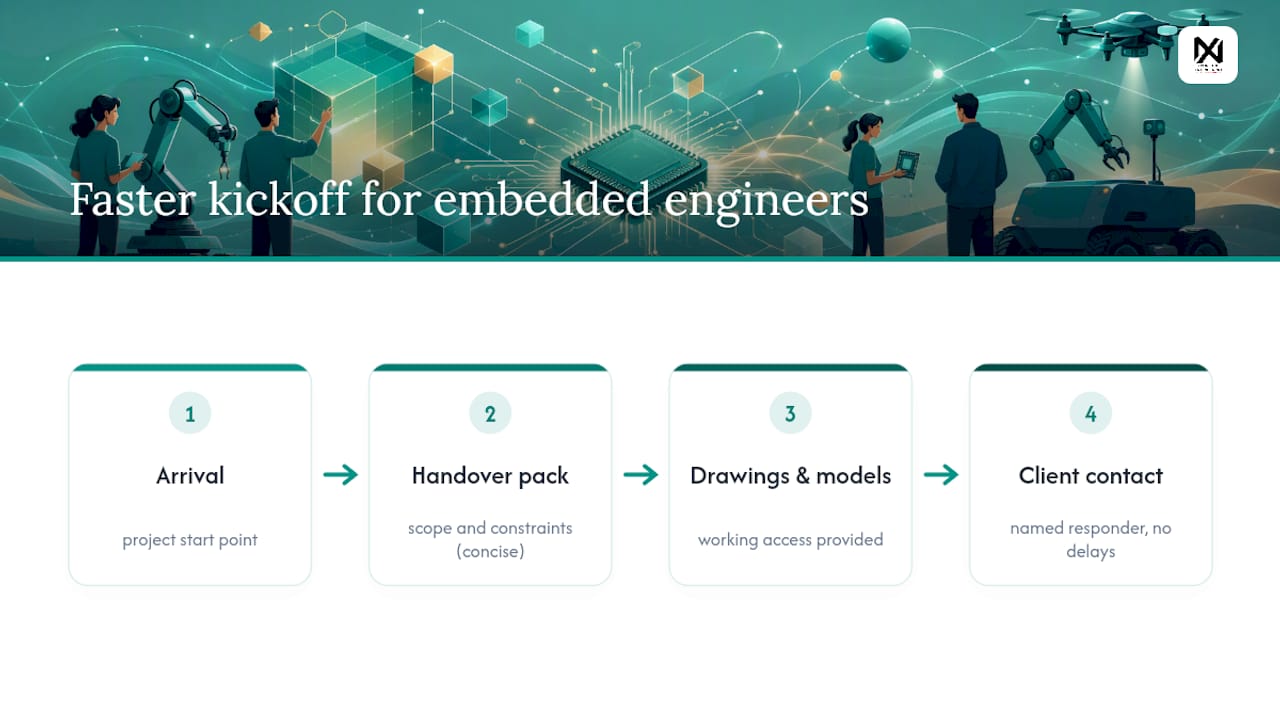
An embedded engineer arriving on a project needs three things to be productive within days rather than weeks: a concise handover pack covering scope and constraints, working access to drawings and models, and a named internal contact who can answer questions without a scheduling delay. Given that handover pack and a host on the client side, an embedded team can move straight into calculations or CAD/BIM coordination instead of spending its first fortnight reconstructing context from scattered emails.
Where standard kickoff advice falls short
Most kickoff guidance treats the meeting as an event to survive rather than a working session that produces something. That’s the gap worth closing. The Atlassian and Slack playbooks get this right by pushing teams towards collaborative exercises rather than one-way presentations, and the evidence backs that instinct: a group that argues out its own vision statement in a breakout room owns that vision far more than a group that reads it off slide six.
What conventional checklists underweight is the handoff moment, particularly when part of the delivery team is external or embedded rather than sitting in the building. A charter and a RACI grid are necessary but not sufficient if the people actually doing the calculations or drawings don’t have access, context, or a named person to ask. Agreeing a minimal “first deliverable” acceptance criterion at kickoff, rather than a vague sense of what week one should produce, is the single addition that prevents early rework in fast-turnaround delivery models.
My honest read: spend less energy perfecting the agenda template and more energy on the pre-read and the 24 hour follow-up. The meeting itself is the easy part. The discipline before and after it is where most projects actually win or lose their first month.
— Mohammed
A faster route to engineering capacity at kickoff
Some teams solve early capacity gaps by hiring locally or stretching existing staff across too many workstreams. Both work, up to a point, but both take time you often don’t have in week one. Xponexusengineering offers a third route: remote embedded civil and structural engineers who plug into your workflow for calculations, drawings and CAD/BIM coordination, working to UK standards and Eurocodes, without the cost or lead time of a permanent hire.

Kickoffs run within 48 hours of engagement, under NDA, with review-ready outputs rather than half-finished drafts landing on your desk. For a project manager who has just run through this checklist and realised the internal team is stretched too thin to cover a new technical workstream, that speed matters more than most other factors combined. Take a look at the engineering services on offer and request a quick consultation to see how fast an embedded engineer could be working inside your project.
Sources
- Project kickoff templates and checklist — Smartsheet
- How to run effective project kickoff meetings that drive results — Slack (blog)
- Project kickoff play — Atlassian Team Playbook
FAQ
What should be included in a project kickoff?
A kickoff should cover the project’s purpose, scope, timeline and milestones, roles and responsibilities, the communication plan, top risks, and a clear set of next steps with owners attached before the meeting ends.
What are the 5 C’s of project management?
Definitions vary across frameworks, so there’s no single agreed list; most versions cluster around communication, coordination, control, clarity of objectives, and completion criteria rather than a fixed formal set.
What are the three key components of a project kickoff meeting?
The three components that matter most are a confirmed shared purpose and scope, named roles and decision owners, and an agreed communication and risk plan, all set out during the meeting itself rather than assumed.
How long should a project kickoff meeting be?
For a moderately complex project, 60 to 90 minutes is typically enough, provided each agenda item is timeboxed and a facilitator enforces the schedule.
Leave a Reply