
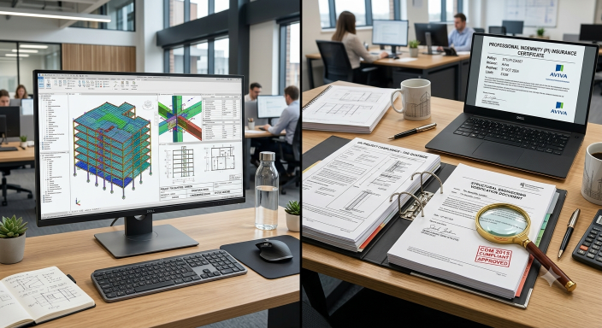
Remote engineering can make procurement faster. Drawings can be reviewed digitally, models shared through a common data environment, and calculation packages produced without every designer sitting in the same office. What does not become remote is professional responsibility.
Before appointing Remote Civil & Structural Engineering Services UK, clients should be clear about who is designing, checking and approving the work, and which organisation is accepting the contractual risk. A calculation pack is only one part of that picture.
A Signature Is Not the Whole Answer
Clients often ask, “Who signs the calculations?” because a name, approval box or professional title provides visible reassurance. Good calculation records should make authorship, checking and revision status clear, but responsibility cannot be reduced to a signature on the last page.
Responsibility normally follows the appointment, scope of services, dutyholder role and work actually undertaken. If a consultancy is appointed to design a beam, frame, foundation or retaining structure, it needs a controlled process showing who prepared the design and how it was checked.
CDM Duties Still Apply to Remote Designers
Under the Construction (Design and Management) Regulations 2015, “design” includes drawings, specifications and design calculations. Designers must consider foreseeable health and safety risks, eliminate them where reasonably practicable and reduce or control risks that remain.
Those duties do not disappear because the engineer works from another city or country. The project team must still manage design risk, exchange relevant information and coordinate with other designers and contractors.

The Principal Designer Is Not Automatically the Structural Engineer
On projects involving more than one contractor, the client must appoint a principal designer to plan, manage, monitor and coordinate health and safety during the pre-construction phase. The structural engineer may take that role, but only where properly appointed and competent to do so.
This distinction matters when buying remote services. A specialist engineer may be responsible for a defined structural package without being responsible for coordinating the entire pre-construction phase. The scope should state that clearly.
PI Insurance Needs to Match the Actual Service
Professional indemnity insurance is intended to respond to certain claims arising from professional services, subject to the wording, exclusions, limits and conditions of the policy. Simply seeing “PI insured” on a proposal is not enough for a risk-sensitive client.
The buyer should check the insured entity, policy limit, territorial scope, relevant exclusions and whether the proposed work falls within the consultancy’s declared activities. Specialist or higher-risk work may require closer scrutiny.
Remote Delivery Makes Information Quality More Important
A remote engineer can only design from the information available. Incomplete surveys, uncertain existing construction, missing geotechnical data or late architectural changes can undermine the assumptions behind otherwise correct calculations.
The appointment should define what information the client must provide and what happens when it is incomplete. If a site visit, opening-up survey or specialist investigation is necessary, that should be identified rather than replaced silently with assumptions.
For Remote Civil & Structural Engineering Services UK, this is a key control. Distance from site is manageable when assumptions, limitations and verification requirements are documented.
Checking Should Be Visible, Not Implied
A professional calculation package should make the design basis understandable. Loads, material properties, assumptions, analysis methods and critical checks should be traceable. Software output alone is not a substitute for engineering review.
Clients should ask how calculations are checked, what level of independence is applied and how design changes are controlled after issue. Current Institution of Structural Engineers guidance places strong emphasis on responsibility, verification and competent checking of calculation models.
Contractual Clarity Prevents Responsibility Gaps
Remote delivery often involves several parties: a UK consultant, an overseas production team, an architect, a contractor and perhaps a specialist fabricator. Problems arise when each assumes someone else owns an interface.
A robust appointment identifies deliverables, exclusions, design interfaces, checking responsibilities, applicable standards, revision procedures and who communicates with Building Control. It should also state whether the engineer is providing design only, drawings, site support or construction-stage review.
Conclusion
Remote engineering is not inherently less accountable than office-based engineering. The real question is whether responsibility is visible, insured, coordinated and supported by a reliable checking process.
Clients should look beyond the signature block. The stronger test is whether the appointed organisation can show competent designers, clear CDM responsibilities, suitable PI cover, controlled assumptions and documented review. When those pieces are in place, remote delivery can be efficient without weakening professional accountability.
Leave a Reply