

Outsourcing architectural drafting is a sound capacity and cost lever for most firms once you control quality through a trial drawing and clear CAD standards. It works because it converts fixed drafting overhead into variable spend, taps Revit and BIM skills you may not have in-house, and clears backlogs fast. Xponexus Engineering’s embedded model, built around RIBA and Eurocode-aware output, is a useful benchmark. Start with a paid trial sheet before committing anything larger.
TL;DR:
- Outsourcing drafting reduces internal workload spikes and provides specialized BIM skills without full-time hiring, offering savings up to 50%.
- A paid trial drawing using your standards and template is critical to verify supplier quality, accuracy, and communication efficiency before a larger commitment.
- Clear standards, version control, and a documented QA process are essential to prevent common errors like scale mismatches and code compliance issues.
- Setting defined file exchange methods, standards, and review checklists upfront ensures seamless workflow and project coordination with outsourcing partners.
- Cost models vary from per-sheet, hourly, fixed packages, or retainers, with the most predictable scope achieving the best value and quality control.
Table of Contents
- What outsourcing architectural drafting covers and when to use it
- Primary benefits for architecture firms
- Risks, common mistakes and how to avoid them
- How to vet and select an outsourcing partner
- Workflow, standards and technical integration
- Typical pricing models and timeline expectations
- Contract essentials: IP, confidentiality and deliverable standards
- How Xponexus Engineering approaches outsourced drafting and engineering support
- Author perspective: when we recommend outsourcing and when to keep work in-house
- How Xponexus can help
- Sources
What outsourcing architectural drafting covers and when to use it
Outsourcing architectural drafting typically means handing off the technical production work while your architects keep design authorship. That covers 2D CAD documentation, Revit-based BIM modelling, permit submission sets, as-built updates, door and finish schedules, and detail sheets. Service pages for architectural drafting show suppliers routinely delivering permit-ready construction documentation with QA checks built in before handover.
Three situations tend to trigger the decision:
- A workload spike that would need a temporary hire you don’t want on payroll long-term
- A project requiring Level of Development (LOD) detail your team doesn’t produce often, such as complex BIM coordination
- A tight submission deadline where internal drafters are already stretched across other jobs
The engagement shape varies too. Some firms send a single project out for one-off drafting support. Others set up a dedicated remote team that works across several jobs in parallel. A growing number embed a remote drafter or engineer directly into their workflow on an ongoing basis, which is closer to having an extra desk than hiring a contractor.
Primary benefits for architecture firms
The clearest benefit is capacity. Outsourcing drafting absorbs the volume spikes that cause bottlenecks, so submission dates stop depending on whether your one Revit specialist is off sick that week. It also gives you access to specialist BIM modelling and detailing skills without carrying a full-time salary, pension contribution and training cost for a role you might only need seasonally.
Cost control follows the same logic. You shift a fixed overhead into a variable one, paying for drafting hours when a project needs them rather than year-round. Supplier pricing pages commonly advertise savings of up to roughly 50% against local in-house production, largely through lower staffing overheads and standardised remote workflows. Treat that figure as directional. It moves with scope, complexity and how much revision work is included.
Turnaround speed is the fourth gain, and it’s often underrated. A supplier running dedicated QA before delivery hands you a document that needs checking, not rebuilding, which cuts the internal rework that quietly eats project margins.
- Faster response to workload peaks without recruitment lead time
- Lower fixed staffing cost, converted to project-based spend
- Access to Revit and BIM specialists on demand
- Reduced internal QA burden when the supplier reviews before delivery
Pro Tip: Ask any prospective supplier to quote their internal QA process before you ask about price. A supplier who can’t describe a review step clearly will cost you more in rework than they save you in hourly rate.
Risks, common mistakes and how to avoid them
Drafting outsourcing goes wrong in predictable ways. Industry guidance on common drafting errors points to incorrect scaling, inconsistent layer and annotation conventions, and version-control mix-ups as the most frequent faults, usually caused by a supplier working from assumptions rather than your actual standards.
Jurisdiction and code risk deserves separate attention. A drafter based overseas may not know your local building control requirements or Eurocode nuances unless you make them explicit in the brief; compliance claims from suppliers are worth verifying against your specific submission authority rather than taken at face value.
- Write a brief that states scale, units, layer names and code references explicitly rather than assuming shared conventions.
- Appoint one internal point of contact for all supplier communication, so instructions don’t fragment across your team.
- Require version-controlled file naming and a sign-off log before anything moves to the next stage.
- Run a documented QA pass on every delivery, even from suppliers with a strong track record.
Pro Tip: Put your CAD standards document in the supplier’s hands before day one, not after the first draft comes back wrong. It’s the single cheapest risk-reduction step available.
How to vet and select an outsourcing partner
Start with technical competence. Ask for evidence of Revit and AutoCAD experience specific to your building type, and check they understand LOD conventions at the level your project needs rather than a generic default. Sample drawings from previous work tell you more than a portfolio slide deck ever will.
Operational fit matters just as much as technical skill. Confirm what service levels they commit to, which communication channels they use day to day, and how they handle version control across shared platforms. A supplier who can’t describe their file-handover process in one clear sentence will struggle under deadline pressure.
The single most effective vetting step is a paid trial drawing. Give a small, representative sheet from a real project, using your own template and standards, and judge the result on accuracy, adherence to your conventions and how quickly it comes back. This reveals communication gaps and standard mismatches far faster than reference calls alone, though reference checks with past clients are still worth doing in parallel.
- Verify Revit/AutoCAD experience against your specific project type and LOD requirements
- Confirm SLAs, communication channels and version-control platform before signing anything
- Commission a paid trial drawing using your own template and a real, representative sheet
- Check pricing transparency, revision allowances and acceptance criteria in writing
Pro Tip: Score the trial drawing against a written checklist, not a gut feeling. Compare accuracy, standard adherence and turnaround time against what was promised, and keep that scorecard for every future supplier comparison.
Workflow, standards and technical integration
Integration succeeds or fails on the boring details agreed before work starts. Fix the file exchange method first: Revit cloud collaboration, IFC export, native AutoCAD DWG, or a shared drive protocol with a clear folder structure. Suppliers offering BIM coordination will usually work across all of these, but you need to state which one your project actually uses.
Layer naming, title blocks, annotation styles and revision numbering all need to be handed over as a written standard, not assumed. The strongest supplier relationships treat this as integration rather than replacement, adopting your drawing conventions rather than asking you to adapt to theirs.
Coordination process comes next: who hands models to consultants, what clash review looks like, and what LOD is expected at each stage. Xponexus Engineering’s tools and digital workflow approach illustrates how an embedded model keeps this coordination inside your existing systems rather than bolting on a separate one.
Close the loop with a review-ready checklist: what “done” means, the turnaround SLA for each deliverable type, and how many rework cycles are included before extra cost applies.
- Agree the exact file format and exchange platform before the first drawing starts
- Share a written CAD/BIM standards document covering layers, title blocks and annotation
- Define clash review and consultant handover points at each project stage
- Set a review-ready checklist and turnaround SLA with a defined rework allowance
Typical pricing models and timeline expectations
Four pricing structures cover most drafting arrangements: per-sheet rates for discrete deliverables, hourly billing for variable scope work, fixed packages for defined document sets, and a retainer or dedicated-resource fee for ongoing capacity. Which one suits you depends on how predictable your workload is.
Cost moves with complexity, the LOD required, how much coordination the drawing needs with other disciplines, and how many revision rounds are built into the quote. Reported savings of up to roughly 50% against local in-house drafting are a useful benchmark figure, though the real number depends heavily on engagement model and revision scope, so treat any headline percentage as a starting point for negotiation rather than a guarantee.
- Per-sheet pricing suits discrete, well-defined deliverables like permit sets
- Hourly billing fits variable or exploratory scope
- Fixed packages work for standard document bundles with known content
- Retainer or dedicated-resource pricing suits firms outsourcing continuously
Compare bids on cost per enforceable deliverable, not headline day rate. A cheaper hourly rate with unlimited scope creep costs more than a slightly higher fixed price with clear inclusions. Always check what QA and how many revision cycles sit inside the number before comparing two quotes side by side.
Contract essentials: IP, confidentiality and deliverable standards
Nail down who owns the final drawing files and what uses are permitted, since IP assignment terms vary between suppliers. Insist on an NDA before any client-sensitive material moves, particularly on commercially confidential schemes. Set written acceptance criteria for each deliverable and clear liability limits, and agree a change-control process covering revision counts and how disputes get resolved before you sign anything.

How Xponexus Engineering approaches outsourced drafting and engineering support
Xponexus Engineering embeds remote civil and structural engineers directly into a client’s workflow, handling calculations, drawings and BIM coordination against UK standards and Eurocodes rather than working as a detached third party.
The firm reports project kick-offs within 48 hours, NDA protection as standard, and cost savings of up to 70% against local hires while the client keeps full control of the relationship with their own customer.
Ask any supplier making similar claims for their kick-off timeline, NDA terms and a sample review-ready deliverable before you commit.
Author perspective: when we recommend outsourcing and when to keep work in-house
Outsource routine documentation, permit sets and BIM detailing when volume outpaces headcount. Keep core concept design in-house where client relationships depend on it. Pilot with one real, low-stakes drawing, score it against your standards, and only scale once turnaround and accuracy both hold up twice in a row.
— Mohammed
How Xponexus can help
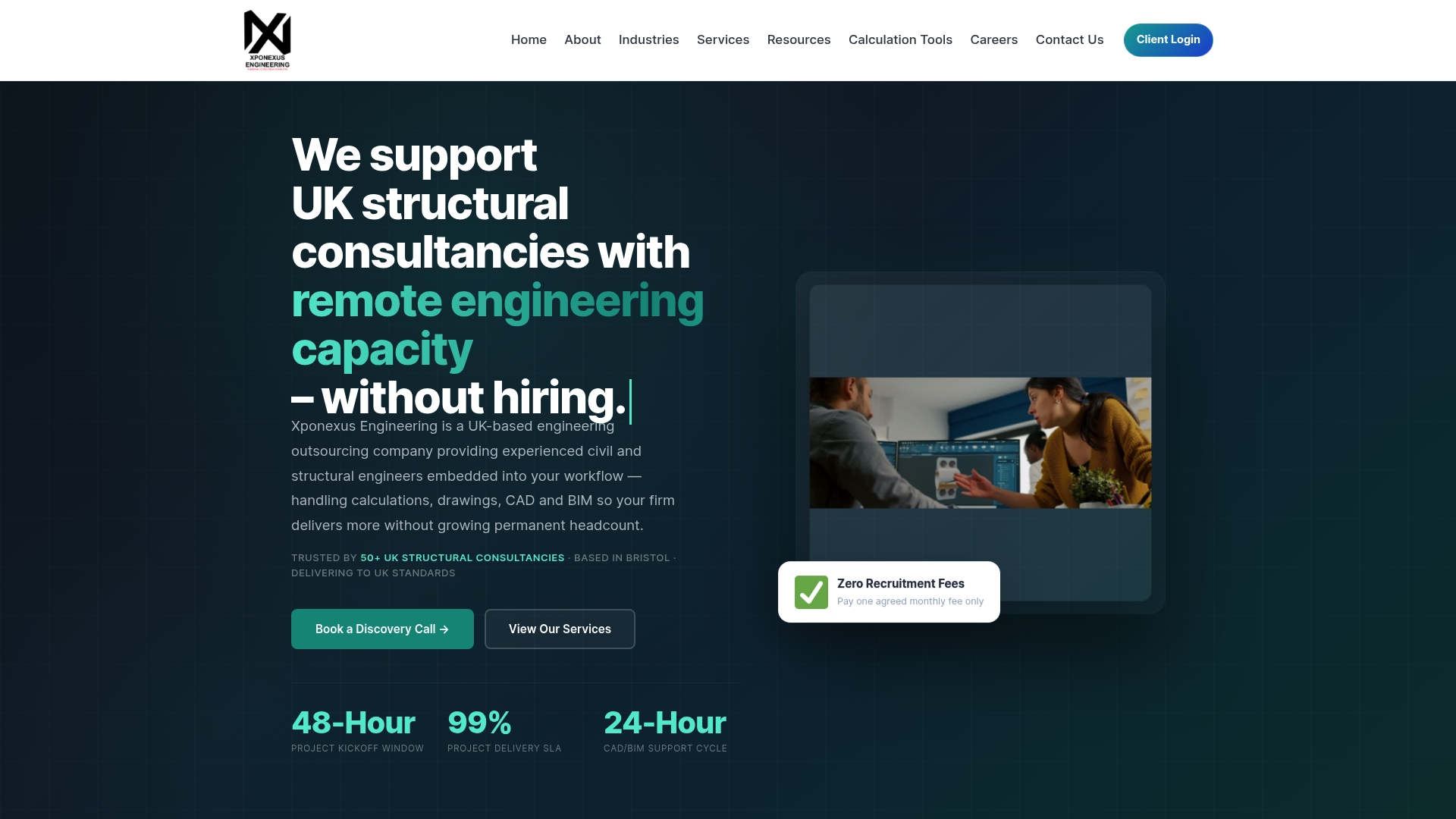
Xponexus Engineering is the practical alternative to hiring another junior drafter or engineer when your workload outpaces your team. Rather than a lengthy recruitment process, you get an embedded remote engineer who works inside your existing project files, calculations and BIM models against UK standards and Eurocodes, without the overhead of a permanent salary.
- Project kick-off within 48 hours of agreeing scope
- Output aligned to UK standards and Eurocodes, delivered review-ready
- NDA protection on every engagement
- Full control retained over your own client relationships
- Reported cost savings against equivalent local hires
If your team is carrying a drafting or engineering backlog right now, the sensible next step is a small trial engagement rather than a long-term commitment. Visit the engineering services page to scope a first project and see how quickly an embedded engineer can start reducing your queue.
Leave a Reply