
A Section 278 agreement is the legal route that lets a developer alter the existing public highway, and the process runs in a fixed order: planning permission, application and fee, technical approval of the design, signed agreement and bond, construction, a Part 1 completion certificate, a maintenance period of at least 12 months, and a final certificate. The stage that decides your programme is technical approval, and it is won or lost on the quality of the drawings and calculations you submit. Consultancies that are short of design capacity at that point can bring in embedded remote engineers, and we cover how below.
This guide is for design teams, project managers and architects who have to get a junction, access or crossing through a highway authority. Councils set their own fees and timescales, so we use published council guidance as worked examples and point you to your authority’s page for the current figures.
TL;DR
- Section 278 of the Highways Act 1980 lets a highway authority agree works to the existing public highway, paid for by the developer, and adopt them at public expense afterwards.
- You apply after planning permission is granted. No work may start in the highway until the design is approved, the agreement is signed, fees are paid and a bond or deposit is in place.
- Fees vary by council. Published 2026 examples range from a fixed £2,000 application fee to percentages of the works value, such as 8.75% in Cornwall and 10% up to £100,000 then 6% in Nottinghamshire.
- Allow months, not weeks: Norfolk’s indicative approval window is three to nine months after the completed design check.
- A clean, complete, review-ready package is the biggest lever you control over time and cost.
Table of Contents
- What a Section 278 agreement is
- Who does what
- The Section 278 process, stage by stage
- What a Section 278 costs
- How long it takes
- Getting through technical approval first time
- Where outside engineering capacity helps
- Take your next submission to the council with support
- FAQ
- Sources
What a Section 278 agreement is
Section 278 of the Highways Act 1980 allows the local highway authority to permit works on the existing public highway and then take them over and maintain them at public expense. The mechanism is a legal agreement. North Yorkshire Council’s developer guidance explains that the authority must be satisfied the works will benefit the public, and that the person who pays all or part of the cost can agree for the works to have particular features or be done in a particular manner.
It is needed where a planning permission requires highway changes. Typical examples are new access junctions, amended junctions and links, and remote mitigation works. Birmingham City Council lists bell mouths, roundabouts, signalised junctions, right-turn lanes, priority junctions and altered signalised crossings.
The same North Yorkshire guidance states that no works may start in an existing public highway without the authority’s written consent, and that doing so without an agreement in place is an offence. The agreement is therefore not paperwork that follows the work. It is the permission to do it.
Section 278 compared with Section 38
The two are often mentioned together. In short, a Section 278 deals with changing a road that already exists, such as a new junction onto it. A Section 38 agreement is the separate route for handing newly built roads inside a development to the authority for adoption. Larger schemes often need both, and the access junction usually has to be dealt with before the estate roads can connect to it. The Department for Transport’s highways adoption advice note says Section 38 discussions should run throughout planning, and it notes that some authorities will insist on designing and building Section 278 works themselves. Ask which approach your authority takes before you commission any design.
Who does what
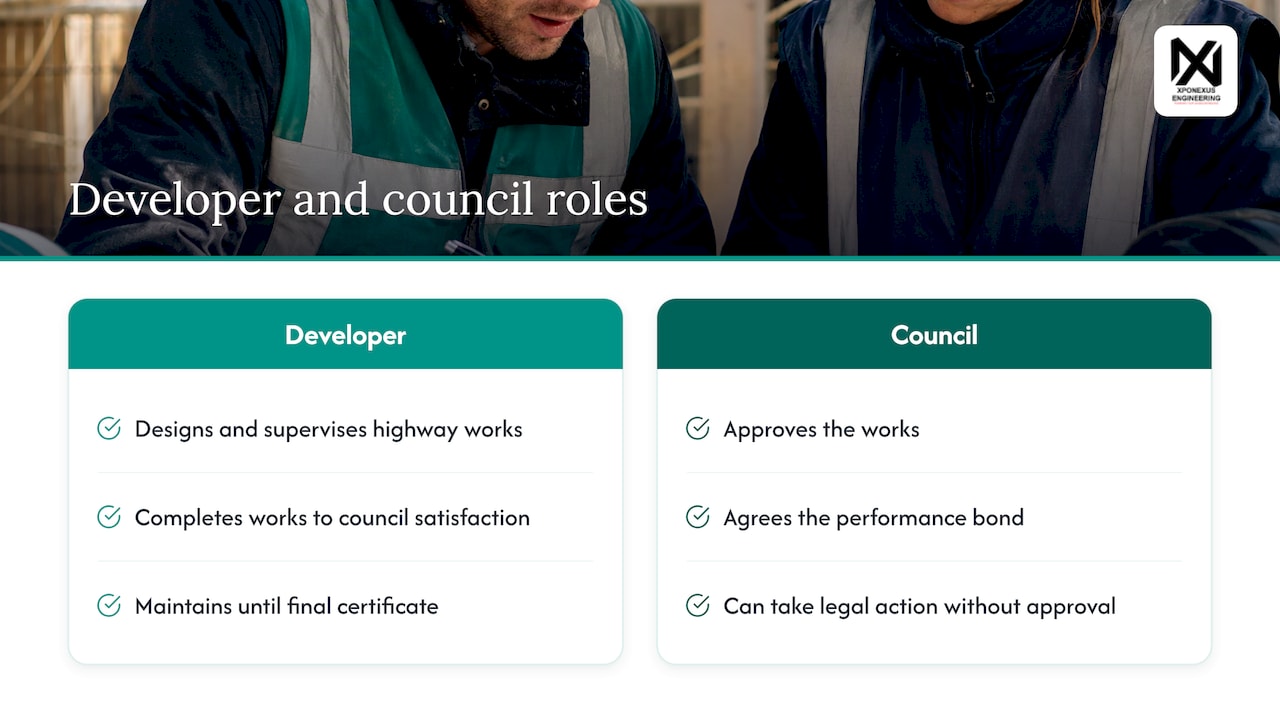
There are two parties: the developer and the council acting as highway authority. Birmingham’s guidance puts the developer in charge of every aspect of the works on the highway, from design through to supervising construction and completing to the council’s satisfaction. The council approves the works, agrees the performance bond and can take legal action if work starts without approval.
South Gloucestershire’s road adoption guide adds a point that catches teams out: the developer acts as street manager and stays fully responsible for maintenance, including damage however caused, until the final certificate.
In practice that makes the design package the developer’s responsibility to get right, with a contractor, a surety and often a solicitor around it. The consultancy preparing the drawings and calculations carries the technical weight.
The Section 278 process, stage by stage
1. Secure planning permission and settle the highway layout
Councils will not process an application until planning approval, full or reserved matters, has been issued. Buckinghamshire Council states this plainly, and Croydon’s guidance says applications can only be made after permission is granted.
Treat the layout approved at planning as provisional. North Yorkshire’s guidance says it is only a general arrangement that can change through technical review, statutory consultation and detailed design. If those changes alter the planning drawings, a variation, often a Section 73 application, may be needed. Planning conditions must also be discharged before works commence.
What goes wrong: designing the junction to planning-level detail, then discovering visibility, drainage or levels do not work once the highway engineer checks them. Resolve this early.
2. Prepare and submit the application
The application pack in Buckinghamshire includes developer, landowner, surety and solicitor details, the planning permission, construction drawings, a location plan and a contractor’s quotation showing the value of the highway works. Some authorities now take applications only through an online portal; Worcestershire states its S278/S38 portal is the only way to submit.
The contractor’s quotation matters more than it looks, because bond and fee calculations often hang from it. North Yorkshire estimates the bond from 110% of the approved tender value.
What goes wrong: incomplete packs. Drawings, specification, calculations and drainage details that do not agree with each other create review rounds, and each round costs weeks.
3. Pay the fees and agree the cost basis
Most authorities want money up front. Nottinghamshire collects about 50% of the likely total fee before design checking starts. Norfolk requires a signed Abortive Cost Agreement and an initial deposit before review begins; because it recharges time, the deposit is not fixed and funds are topped up or refunded as the process runs. More on fees below.
4. Technical approval of the design
This is the long middle of the process. The authority checks your detailed design against its standards: geometry, safety audit where required, structures, street lighting, signals, drainage, materials and specification. Norfolk’s published timescales give four weeks to first engineer contact, 12 weeks for the first drawing-package response and four weeks for each revised package.
Suffolk’s February 2026 guidance sets a tighter target for straightforward schemes: initial review within 10 working days of payment or a full design package, preliminary comments within 20 working days, and technical approval typically about six weeks from initial review.
The pace is driven by what you submit. Norfolk lists submission quality, complexity, consultant response times, number of iterations and council workload as the factors. Only some of those are in your hands, and quality and response time are the two that are.
5. Sign the agreement and provide the bond
The agreement is signed by both parties with the performance bond agreed before work begins. St Helens Borough Council explains the security is either a cash deposit or an institution-backed surety bond calculated by the council, which can be called on to finish the works if the developer defaults or goes into liquidation.
A bond or deposit is only one item on the pre-start list. Buckinghamshire’s list also requires approval of all technical details, all fees paid, an approved road space booking permit, and any relevant easements and licences. Worcestershire adds that street works permits must be in place. If land dedication or an easement is needed, Norfolk requires title to be registered at HM Land Registry before the agreement completes, so start that early.
The contract-side workflow, from approvals to sign-off, is easier to keep on track with tooling; this piece on automating construction approvals covers the kinds of steps worth systematising.
6. Build the works
Commencement is only permitted when the agreement is signed, technical details approved, fees paid and permits secured. The works must follow the approved details. Worcestershire notes the authority may enforce conditions, including calling on the bond if the developer fails to comply. Construction should also be booked well ahead: Croydon asks for works to be planned at least 16 weeks in advance.

7. Part 1 completion certificate and the maintenance period
When the items in the highways schedule are complete, the council issues a Part 1 certificate. South Gloucestershire describes this as starting a maintenance period of not less than 12 months. Field Seymour Parkes, a law firm, notes the initial maintenance period is usually one year, with bond released incrementally. Nottinghamshire says that after a first certificate the bond can usually be reduced to a minimum of 40% of its original value plus any outstanding commuted sums, at the authority’s discretion.
8. Final certificate and adoption
After remedial works, and submission of as-built surveys, asset records and testing certificates, the council issues the final certificate, releases the bond and takes over maintenance. Gathering as-built information is a task to plan from the start of construction, not at the end.
What a Section 278 costs
There is no national tariff. Each authority sets its own, and the figures below are examples of how they are built, as published for their period. Check your council’s current fee page before budgeting.
| Authority (period) | Published fee basis |
|---|---|
| Nottinghamshire (April 2026) | 10% of estimated works cost up to £100,000, 6% thereafter, £1,000 minimum |
| Suffolk (February 2026) | Full S278: 7.5% of bond plus £5,000. Abridged S278: 10% plus £1,500, for works under £30,000 |
| Cornwall (2026/27) | £2,800 application fee and 8.75% agreement fee, minimum £2,800; minor works 9.5% technical approval fee |
| Croydon (June 2024) | Non-refundable £2,000 application fee, then a set fee for council design or review |
| Norfolk | Time-recharged deposit under an Abortive Cost Agreement |
The authority’s fee is only part of the total. Nottinghamshire lists the works themselves, the bond, £10m public liability insurance, legal fees and any commuted sums.
Commuted sums
A commuted sum is a payment covering the authority’s future maintenance of items that cost more than standard highway to look after. Leicestershire’s design guide says none is normally applied to existing carriageway unless it is replaced with a non-standard material, but a full sum is required for additional carriageway such as right-turn lanes or for new features like refuge islands, lighting and bollards. Its formula uses a 2.2% discount rate and a 60-year maintenance period, 150 years for structures, with payment before the final certificate.
The design lesson is direct. Specifying standard materials and avoiding unnecessary features reduces the sum, so decide this during design, not after the council’s comments arrive.
How long it takes
Expect the agreement to take months. Norfolk’s indicative figure is three to nine months for approval after the completed design check, and up to nine months if a Traffic Regulation Order is needed. Suffolk’s six-week technical approval target is for straightforward projects. Your own authority’s page will say what applies.
The delays that repeat across council guidance are the same ones:
- an incomplete first submission
- slow consultant responses to comments
- planning changes that force a variation
- unregistered land or missing easements
- unpaid fees or deposits holding up the review
- road space or permit bookings not secured
Getting through technical approval first time
Every authority’s guidance points at the same thing: the review runs on submission quality. A practical approach is to treat the submission as a package to be checked before it goes, not drawings to be corrected afterwards.
- Check that the planning drawings, construction drawings and specification agree on levels, geometry and materials.
- Make sure drainage proposals tie into the highway layout. Our guide to a drainage strategy report shows what reviewers look for on the drainage side.
- Confirm the pavement build-up is stated and justified. Our note on pavement design layers sets out what goes where.
- Run an internal review before submission. A design review checklist catches the inconsistencies that cause revised-package rounds.
- Where retaining walls, structures or foundations are involved, make sure the calculations are complete and follow Eurocodes. See how Eurocode 7 is applied in practice.
- Agree who answers council comments and by when, so that the four-week revision cycles are not extended by your own side.
Where outside engineering capacity helps
Section 278 work arrives in bursts. A planning approval lands, the council wants a full package, and the team that drew the planning layout is already committed elsewhere. Hiring for that peak is slow and leaves a fixed cost afterwards.
Xponexus Engineering supplies remote civil and structural engineers who embed in your workflow and work on your calculations, drawings and BIM coordination, with outputs aligned to UK standards and Eurocodes. Our civil engineering service covers surface water and foul drainage design, and our CAD and BIM team produces the drawing sets. We can start within 48 hours, work under NDA, and you keep the client relationship throughout. For a consultancy with a council submission to turn around, that means adding capacity to the package without a permanent hire.
Our view on the Section 278 process
Most of the time lost in a Section 278 is not the council’s. It is the gap between a planning-stage layout and a package a highway engineer can approve without sending it back. Each returned package costs a revision cycle, and the published council timescales show how long those cycles are.
We think the fix is capacity at the right moment and discipline in the package. Calculations, drawings and drainage details need to agree before submission, and the people checking them need time. That is what embedded engineers are for: they work inside your process, to your standards, so the submission goes out complete and your team stays in front of the client and the council.
We also think firms should not have to carry a permanent team sized for their busiest month. Flexible, NDA-protected capacity that starts within 48 hours lets you take on the approval that arrives unexpectedly and still deliver it properly.
Mohammed
Take your next submission to the council with support
If you have a Section 278 package to prepare and not enough engineering hours to do it, our remote engineering support puts experienced civil and structural engineers into your workflow. We handle calculations, drawings and CAD/BIM coordination so that the package is review-ready, with project kick-off within 48 hours and your client relationship left with you.

For drainage and civil design inside a highway scheme, see our civil engineering page; for drawing production, our CAD and BIM services.
FAQ
What is the difference between a Section 278 and a Section 38 agreement?
A Section 278 covers works to an existing public highway, such as a new access junction, paid for by the developer and adopted afterwards. A Section 38 is the route for handing newly built roads within a development to the authority. Larger schemes often need both.
Can I start work before the agreement is signed?
No. North Yorkshire’s guidance states that works in an existing public highway need the authority’s written consent and that starting without an agreement is an offence. Councils such as Worcestershire also require approved technical details, paid fees and street works permits before commencement.
How much does a Section 278 cost?
It depends on the authority. Published 2026 examples include 10% of estimated works cost up to £100,000 then 6% in Nottinghamshire, and an 8.75% agreement fee in Cornwall. Add the works, bond, insurance, legal fees and any commuted sums.
How long does a Section 278 take?
Expect months. Norfolk’s indicative window is three to nine months for approval after the design check, while Suffolk targets about six weeks for technical approval on straightforward schemes. Submission quality and your response times drive much of the difference.
Sources
- Section 278 guidance for developers, North Yorkshire Council
- What is an s278 agreement?, Birmingham City Council
- Highways Adoption advice note, Department for Transport
- Road adoption guide, South Gloucestershire Council
- Apply for a Section 278 Agreement, Buckinghamshire Council
- Section 278 submissions, Norfolk County Council
- What is a Section 278 agreement?, St Helens Borough Council
- Accesses, Junctions and S278, Nottinghamshire County Council
- Guidance for S278 Agreements, Suffolk County Council
- Highway and Infrastructure Adoption fees, Cornwall Council
- Guidance for Developers, Croydon Council
- Leicestershire Highway Design Guide Part 4f: Commuted sums
- Automated approvals in construction
Leave a Reply